What to Do When Your Leadership Strengths Become Liabilities
Key Takeaways:
- Most leadership under pressure is reactive, not intentional. The behavior that earned you the role, being decisive, supportive, or analytical, intensifies under stress into a pattern that limits the people around you. And you are almost certainly the last person to notice.
- You have roughly six seconds to change course. After a trigger fires, a brief neurochemical window opens before your default pattern takes over. Name the pattern, use a physical reset, and ask one better question. That’s the practice.
- Your team already feels your pattern before you see it. 70% of a team’s engagement is attributable to their manager. When you interrupt your own reactivity, you change what it feels like to work for you.
A divisional leader at a global industrial services company was known for being hands-on. He walked every site, knew every project by name, and could tell you the status of any job within seconds. His team respected his grip on the operation. His board valued his reliability.
What nobody talked about was the cost. His direct reports had stopped making decisions without checking with him first. Two capable managers had left in eighteen months. New ideas were dying in inboxes because nobody wanted to bring something forward that hadn’t been pre-approved. His grip on the operation had become a grip on his people.
He wasn’t a bad leader. He was a reactive one. The same drive that had earned him the role was now running on autopilot, and under sustained pressure, it had intensified from “high standards” into control that was slowly suffocating the team around him.
This is more common than most organisations realize. The behavior that wins promotions, that gets people labelled “decisive,” “supportive,” or “thoughtful,” is often a polished stress response running unchecked.

This article is a practical guide. It will help you:
- Recognize which reactive pattern you default to under pressure
- Understand the biology and attention dynamics that keep the pattern hidden
- Use a six-second practice to interrupt the pattern and choose a purposeful response
When Your Best Strength Becomes a Stress Pattern
Every leader has a core strength they’re known for. Under normal conditions, that strength serves them well. Under sustained pressure, it doesn’t evolve. It intensifies.
This is the trap. The behavior that made you successful is the same one that limits you. It’s not a character flaw. It’s a survival strategy that worked brilliantly at an earlier career stage and now runs on autopilot.
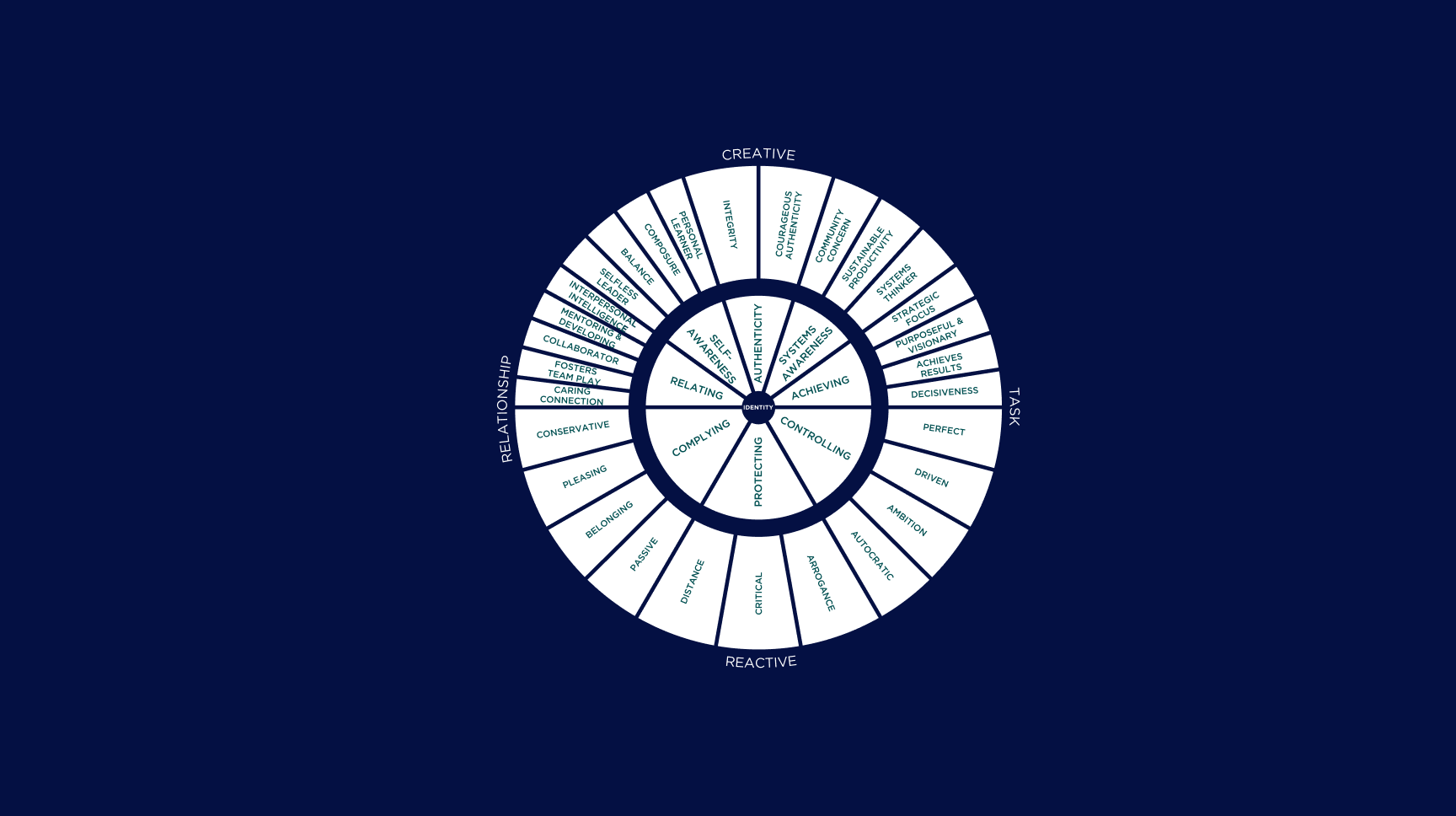
Leadership researchers Robert Anderson and William Adams identified three reactive tendencies that account for the vast majority of leadership under pressure. They map to our oldest survival instincts: fight, flight, and the often-overlooked fawn response.

All three reactive types share a common thread. Under pressure, they are more concerned with how they are doing than what they are doing. They over-control, avoid real issues, say what they’re expected to say in the meeting, and have the honest conversations in the corridor afterwards.
When Primeast worked with Cape plc (now Altrad) on a multi-year leadership programme for senior operational leaders, one finding surfaced repeatedly. The leaders who were most technically capable were also the ones most likely to hold on too tightly. They knew every detail of the operation. That knowledge was their value. Under pressure, they defaulted to doing more themselves rather than trusting the people around them. The programme’s most significant outcome was not a new skill but a shift in behavior: leaders learning to let go. As the programme sponsor noted, delegation was the single biggest benefit, because it unlocked capacity across the entire team, not just the individual.
A Necessary Distinction
Before going further, something important:
Not every reactive response is a problem.
A controlling response during a genuine safety crisis is not a pattern to interrupt. A protecting response when you genuinely need more information before deciding is not avoidance. A complying response when the situation calls for diplomacy is not fawning.
The issue is not the response itself. It is the automaticity. If you are choosing the response, that’s leadership. If the response is choosing for you, that’s a pattern. The test is simple: could you do something different right now, or does the idea of doing something different create anxiety? If it creates anxiety, the pattern is in charge.
Quick Self-Check
Under pressure, do you tend to:
- Appease? You smooth things over, say yes when you mean no, and worry more about how people feel about you than what the situation needs.
- Push harder? You take control, speed up, talk over, and feel a rising frustration that others can’t keep pace.
- Step back? You go quiet, retreat into your head, and tell yourself you’ll deal with it later.
Now push deeper. Your pattern is not fixed across every situation. It shifts depending on context. Ask yourself:
- When you’re tired? Fatigue strips away your coping mechanisms. The pattern that emerges at 5pm on a Friday is often your truest default.
- In front of your boss? Authority relationships activate reactive patterns that peer relationships may not.
- When the stakes are personal? A restructure that threatens your role will surface a different pattern than a project deadline.
The pattern that runs your behavior in these moments is the one worth understanding. Not the version of yourself you see when everything is going well.
Why You Don’t See Your Own Patterns
If these patterns are so common, why don’t leaders notice them? Start with what a typical day looks like:
- Back-to-back calls from 8am
- A strategy question sandwiched between two operational fires
- Twelve “just quickly…” messages before lunch
- A difficult conversation at 2pm followed by a board update at 2:30
- By 5pm, dozens of decisions made, and the first three are a blur
In this environment, there is no bandwidth left to notice how you’re showing up. Every interaction becomes a micro-reaction. The question shifts from “What does this situation need from me?” to “What do I need to get through this?”
“I’m too busy to think” means “I’m too busy to notice I’m on autopilot.”
Research backs this up. Chronic partial attention degrades decision quality, emotional regulation, and cognitive flexibility. The more overloaded leaders become, the more they rely on automatic patterns. The less they notice they’re doing it.
When Novartis Oncology commissioned Primeast to develop a series of Emotional Intelligence programmes for their management teams across Europe and the US, the starting insight was not that leaders lacked skill. It was that they lacked self-perception. Using the EQi diagnostic across five dimensions, including self-perception and stress management, leaders consistently discovered a gap between how they thought they were showing up and how their colleagues experienced them.
As the programmes expanded from managers to executives, with 360-degree feedback and personalized coaching, the pattern was consistent: the leaders who believed they needed the least help were often the ones with the largest blind spots.
| The Attention Problem | The Impact |
|---|---|
| Attention constantly pulled outward: emails, crises, updates, requests | No bandwidth to notice internal cues that your default is running |
| Only 10–15% of leaders possess genuine self-awareness (Harvard/Eurich) | Less than 30% correlation between actual and self-perceived competence |
| Leaders rising to senior levels show increased hubris, decreased empathy | Reactive patterns feel like “just the way I lead” and stay invisible |
The good news: to change this, you don’t need more time. You need micro-moments of attention. Specifically, about six seconds of it.
The Biology Behind the Pause
There’s a reason “just pause and think” sounds like empty advice. Without understanding what’s happening in your body, the pause feels impossible.
When you encounter a trigger, your amygdala fires before your conscious mind catches up. Daniel Goleman called this the amygdala hijack. It happens in milliseconds. Stress hormones flood your system. Neurochemical changes impair prefrontal cortex function, reducing your access to the part of the brain responsible for strategy, nuance, and empathy. Your body shifts toward survival mode.
Think of it this way: under stress, your brain’s CEO (the prefrontal cortex) gets sidelined and the security guard (the amygdala) takes the controls. The security guard is excellent at spotting threats. It is terrible at strategy, nuance, and relationships. This is a simplification of a complex neurological process, but as a working model for what leaders experience in the moment, it holds.
Under sustained stress, this shift becomes chronic. Research published in Nature Reviews Neuroscience shows that prolonged stress damages the structure of the prefrontal cortex while amplifying the amygdala’s reactivity. Leaders can become more impulsive and less curious over time. Not because they choose to. Because their biology is pushing them there.
The cascade works like this:
- Trigger fires (confrontational email, unexpected challenge, underperformance)
- Amygdala activates in milliseconds, before conscious thought.
- Stress hormones surge, impairing prefrontal cortex function.
- Pattern activates: complying leaders appease, controlling leaders push, protecting leaders withdraw.
- Within roughly six seconds, the initial neurochemical spike begins to settle. This is the window.

A quote widely attributed to Viktor Frankl captures it:
“Between stimulus and response there is a space. In that space is our power to choose our response.”
Whether or not Frankl wrote those exact words, the insight is sound. That space is roughly six seconds, and it’s where your leadership lives.
Your Team Is Already Experiencing Your Pattern
Before we get to the practical guide, it is worth understanding what is at stake beyond your own performance. Your team is not experiencing your intentions. They are experiencing your nervous system.
When you lead from chronic activation, your team mirrors it. They become cautious, defensive, or appeasing. The effects compound:
- Dialogue shortens. People stop bringing bad news.
- Innovation declines. Risk-taking feels unsafe.
- Responsibility flows upward rather than outward.
- High performers start looking for the exit.
Gallup’s research puts this bluntly: 70% of a team’s engagement is attributable to their manager. If you manage ten people, you’re the primary reason seven of them either show up energised or quietly start looking elsewhere.
Manager engagement itself fell to 27% in 2024, the steepest decline of any employee group. Disengaged managers leading disengaged teams, all reacting rather than choosing, is a pattern that compounds through every layer of an organisation.
When Rolls-Royce undertook the acquisition of a Spanish aerospace joint venture, they commissioned Primeast to run a cultural due diligence before integrating. Using the Barrett Values tool, we developed values-based surveys across more than 600 respondents and facilitated workshops, the process revealed that the “ways of working” in each organisation were not just structural. They were direct reflections of how leadership teams were showing up under pressure.
The cultural stretch between the two businesses was bridgeable, but only because the leadership team chose to understand their own patterns first, rather than assuming the other side needed to change. The same principle applies inside any team. The culture your people experience is, to a significant degree, the pattern you are running.
When you interrupt your own reactive pattern, you are not only improving your leadership. You are changing what it feels like to work for you. That is the real reason to care about the next six seconds.
How to Recognize Your Pattern in Real Time
Knowing your type is the starting point. Catching it in the moment is the skill. There are two channels to pay attention to: your body and your thoughts.

Pick one or two body signals that feel most familiar. These are your early-warning system. They fire before your mind has time to rationalise what’s happening.
Then notice the thought scripts. Under pressure, your mind produces the same story, and it’s rarely questioned. Try finishing this sentence: “Under pressure, my inner voice usually says…” The answer will point you toward your pattern faster than any assessment tool.
What to Do With Your Six Seconds
Once you can recognize the pattern, the goal is not to crush it. It’s to use those six seconds differently.
Step 1: Name It, Don’t Fight It
In the moment, say to yourself: “This is my complying pattern showing up.” Or controlling. Or protecting. Whatever fits.
The act of naming shifts you from being inside the reaction to observing it. Susan David, a Harvard psychologist, describes this as the difference between being “hooked” by an emotion and being able to hold it at arm’s length. You don’t need to eliminate the feeling. You need to stop it from making your decisions.
Step 2: Use a Physical Reset (6 Seconds)
Three options. Pick the one that works for you:
| Reset Method | How It Works |
|---|---|
| Three slow breaths | Inhale for four counts, exhale for six. The longer exhale activates the parasympathetic nervous system and begins to settle the stress response. |
| Feet and shoulders | Press your feet into the floor. Drop your shoulders. This grounds you physically and interrupts the fight-or-flight tension pattern. |
| Slow down deliberately | Take a sip of water. Shift your posture. Do one thing at a speed that feels slower than the conversation demands. |
You’re not wasting time. You’re buying back your judgement.
Step 3: Ask One Better Question
Each reactive pattern has a default question it’s trying to answer. Replace it:
| Pattern | Default Question | Better Question |
|---|---|---|
| Complying | How do I keep everyone happy? | “If I wasn’t trying to keep everyone happy, what honest thing needs saying here?” |
| Controlling | How do I get this under control? | “If I trusted this team 10% more, what would I do differently right now?” |
| Protecting | How do I avoid exposure? | “If I brought one small piece of my thinking into the room, what would I share?” |
These questions don’t require a grand shift in personality. They ask for one small, different move. Over time, those small moves rewire the pattern.
Training, Not Trying Harder
A pattern you’ve repeated for twenty years will not change because you read an article about it. Knowing your pattern and interrupting it under real pressure are two different skills.
Don’t Wait for a Crisis to Practise
Your pattern doesn’t only appear in high-stakes moments. It shows up everywhere. Use low-stakes situations as your training ground:
- The slightly late start to a meeting
- The awkward email you’d rather ignore
- The minor disagreement with a peer
- The Tuesday afternoon call that’s mildly irritating
A practical challenge: for one week, pick your dominant pattern and practise the six-second pause once a day. Not in a crisis. In a routine moment where the pattern still shows up. That’s where the muscle gets built.
Why You Need Other People in the Room
Reactive patterns are, by definition, hard to see from the inside. They feel like “just the way I lead.” External input changes this:
- A trusted colleague who can say “You’re doing the thing again” mid-meeting
- A coach who can spot the pattern before you feel it
- A structured environment where you can experience your triggers and practise a different response, without the consequences of getting it wrong in front of your board
This is where experiential learning earns its weight. In simulated pressure scenarios, leaders feel the same physiological responses they feel at work. But with skilled facilitation, they get to pause, examine what drove the behavior, and try a different response. Then do it again.
When Altrad designed its Xcelerator Programme with Primeast, the structure reflected this principle. Ninety-six emerging leaders went through a combination of immersive experiential workshops, DISC 360 assessments, one-to-one coaching, and three-way calls with their line managers. The assessments revealed patterns. The coaching created space to examine them. The workshops gave leaders a room to practise under pressure. Fifteen of those leaders have since stepped up into Head of Department roles. Not because they learned a theory, but because they built a new set of reflexes in an environment that felt real enough to transfer back to work.
The shift is from what Robert Kegan calls the Socialized Mind, where your behavior is shaped by what others expect of you, to the Self-Authoring Mind, where you act from your own values. You know the difference. One leader walks into a room and immediately scans for who looks unhappy. Another walks in and asks what the situation needs. The first is being led by a pattern. The second has authored a response. That shift does not happen through insight alone. It happens through repeated, embodied practice under conditions that feel real. New neural pathways are built through practice, not theory. Every time a leader catches their pattern and chooses differently, the pause gets easier. The default gets quieter.
From Reactive to On-Purpose
You don’t need to become a different person. You need to change what you do with a few critical seconds.
| Reactive Leadership | Purposeful Leadership |
|---|---|
| My pattern decides for me | I notice my pattern and choose |
| Attention scattered by everything | Attention directed by values and strategy |
| Playing not to lose | Playing to win |
| Six seconds on autopilot | Six seconds of conscious choice |
The shift is small. Name the pattern. Use the pause. Ask a better question. Do it again tomorrow.
One invitation to close. Name your primary pattern. Share it with a trusted colleague. Ask them: “Next month, will you tell me when you see this pattern? And when you do, will you give me a moment to take my six seconds?”
That’s how change starts. Not with a programme or a framework. With one honest conversation and a willingness to practise.
Ready to Move Forward
Most leaders mean well.
Strategies only work when your leaders have the confidence and capability to use them. Primeast combines change management training with consulting and coaching to help organisations move from planning to lasting change.
How we help: Change Management Training · Change Consulting · Leadership Coaching