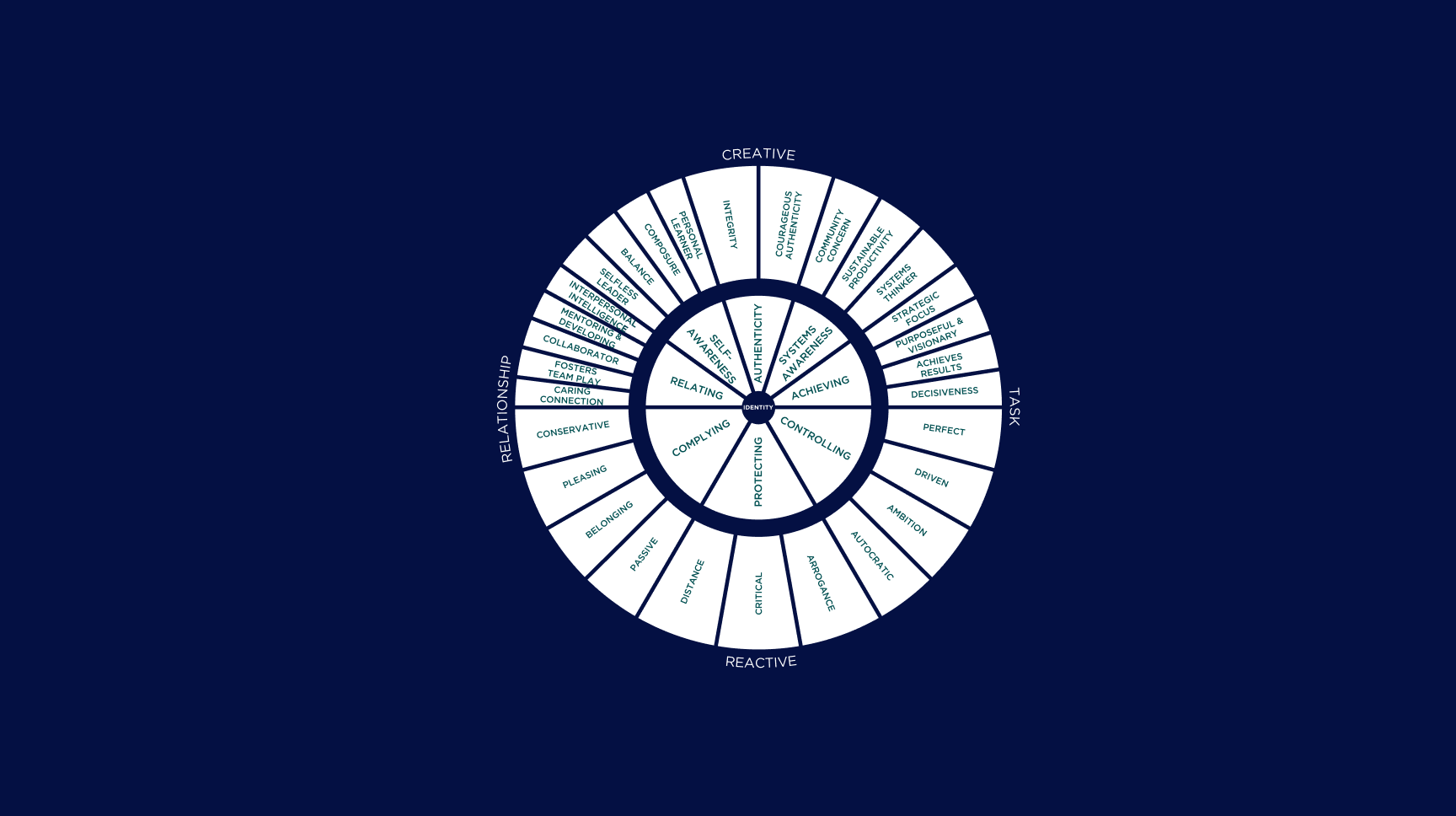
Most Leaders Aren’t as Self-Aware as They Think
Key Takeaways:
- 95% of leaders think they’re self-aware. Only 10-15% are. The gap between how you see yourself and how others experience you is larger than you think.
- Your intent doesn’t equal your impact. Every word from a leader carries more weight than intended. Small moments create lasting impressions.
- Awareness without action is self-indulgence. A 66-day experiment with feedback, reflection, and one specific behaviour shift changes how you lead.
That’s not a typo. Tasha Eurich’s research research found that the vast majority of us are operating with a distorted picture of how we come across. Harvard Business School research shows less than a 30% correlation between people’s actual competence and their self-perceived competence. Leaders consistently overrate their own abilities.
This matters because leaders are the single biggest factor in whether employees thrive or leave. Gallup’s data shows that up to 70% of variance in employee engagement depends on the leader. If you manage ten people, you’re the main reason seven of them either show up energized or quietly start looking elsewhere.
Two things happen as people rise through leadership. They get less honest feedback. They gain more confidence. The Dunning-Kruger effect compounds this: those least skilled in a particular area are often the most confident in it. The people who most need to examine their impact are the least likely to think they should.
If you’re reading this and thinking, “I’m one of the self-aware ones,” you might want to pause. That confidence is precisely what the research warns about.
Am I in the 10-15%?
Before reading on, try answering these five questions:
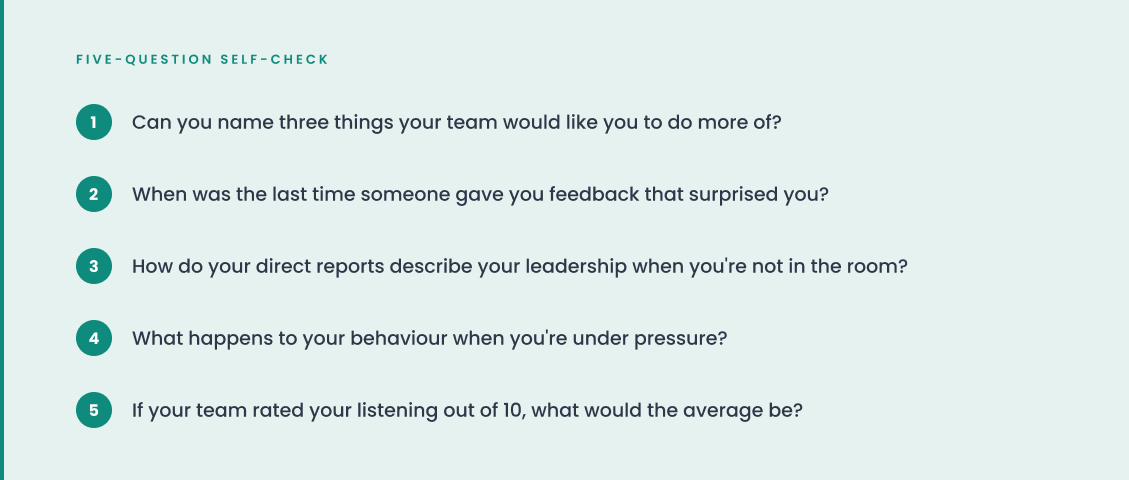
If you struggled with any of those, you have company. And you have work to do.
When Your Good Intentions Still Hurt Your Team
Intent is your subjective experience of your words and actions. Impact is the other person’s. The space between them is where most leadership friction lives.
You think you’re being decisive. They experience you as dismissive. You think you’re pushing for high standards. They feel paralysed by fear of failure. You cancel a one-to-one to protect your calendar. They conclude they’re not a priority.
A casual remark between peers might be forgotten by lunchtime. The same remark from a leader gets replayed for days. Because leaders carry positional power, every word lands heavier than intended.
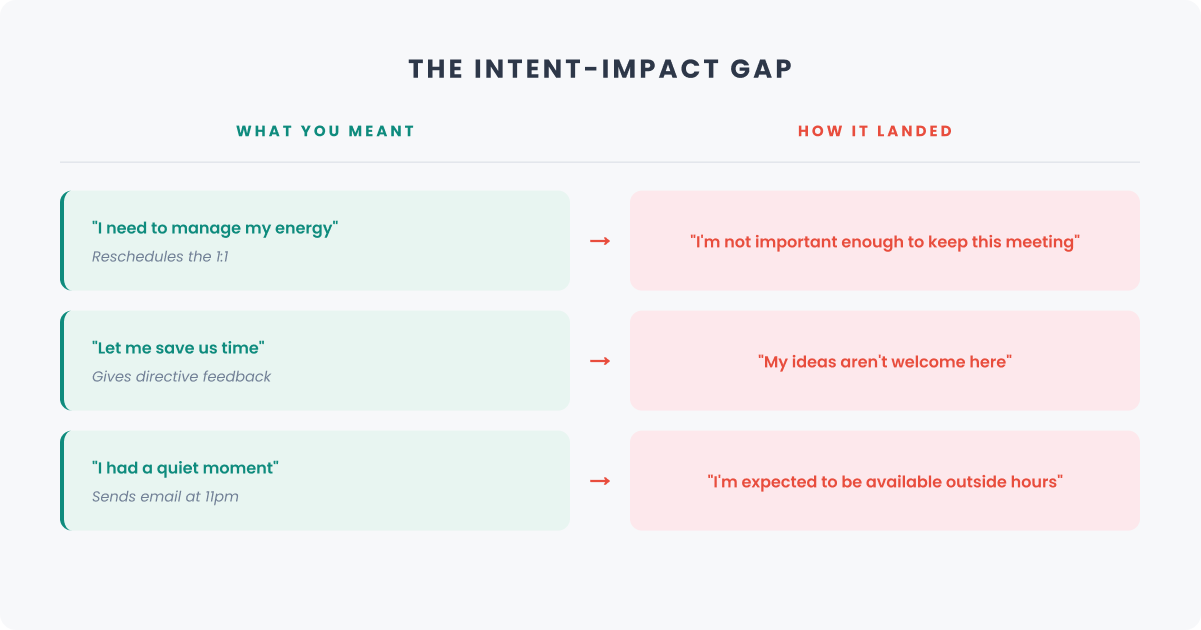
In each case, the intent was reasonable. The impact was corrosive. And the leader never knew.
Why This Costs More Than You Think
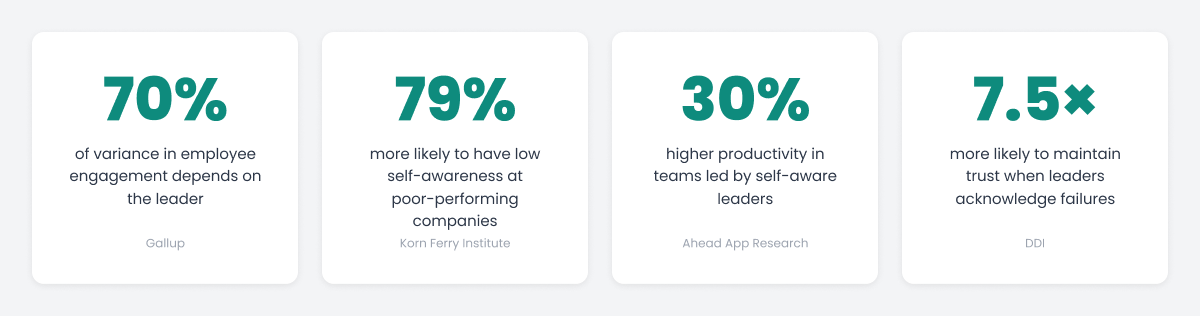
A 10-year study by Green Peak Partners and Cornell University found that self-aware leaders with strong interpersonal skills delivered better financial performance than “results-at-all-costs” executives. Understanding your impact isn’t a development exercize for the keen. It’s a performance strategy.
How to See Yourself the Way Others Do
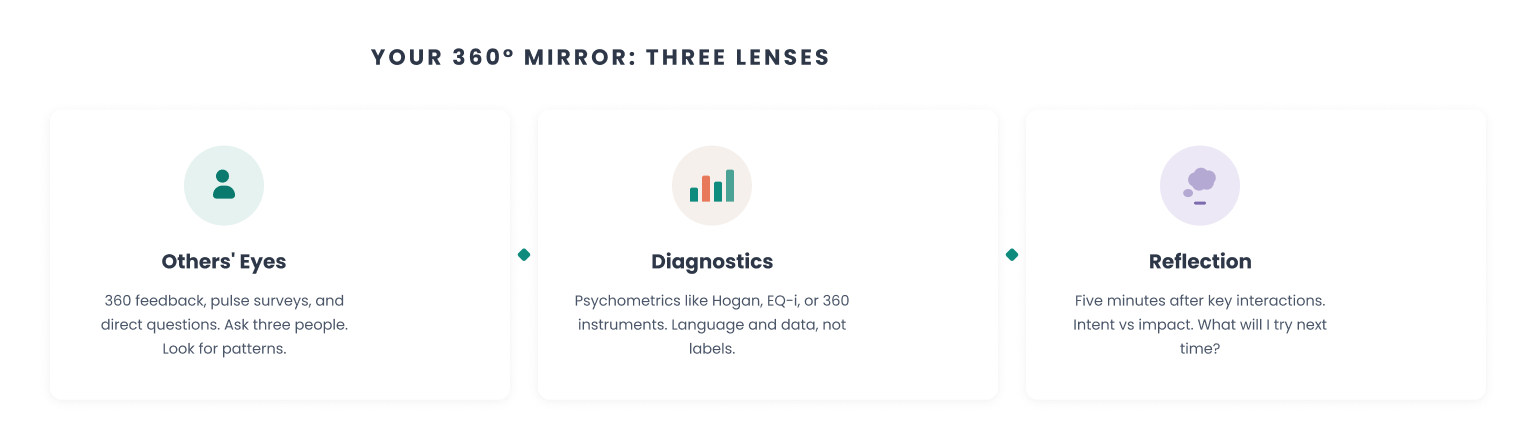
The gap between intent and impact doesn’t close on its own. It closes when leaders build a 360-degree mirror: a combination of feedback, diagnostics, and reflection that gives you an honest picture of how your behavior lands.
No single source is enough. Gut feel is unreliable. Annual reviews are too infrequent. You need three lenses working together.
We ran an Emotional Intelligence programme with Novartis Oncology using the EQ-i diagnostic. It started as a workshop series for middle managers, helping them understand their own EI and its impact on others. The results were strong enough that Novartis expanded the programme to executives, adding a 360 version of the assessment and one-to-one coaching.
The outcome across supervisors, managers, and executives: measurable improvements in self-perception, interpersonal skills, and what Novartis described as “positive mirrored behavior” spreading through teams. Leaders weren’t keeping the insight to themselves. It was changing how whole teams worked.
That’s the thing about a good diagnostic. It doesn’t give you a label. It gives you a starting point for a different conversation.
A 2024 NIH-published study found that after a structured 360-based development programme, leadership assessments by supervisors improved from 61.5 to 91.0. Edgecumbe research showed integrating 360 feedback with coaching led to 55-60% improvements in leadership effectiveness. No single source is enough. The combination is what works.
You don’t need a formal 360 to start. Three low-friction questions can shift your perspective within a month:
- “What’s one thing I do that helps you do your best work?”
- “What’s one thing I do that gets in your way?”
- “When am I at my best as a leader?”

Handling Hard Truths
Building a 360-degree mirror only works if you can sit with what it shows you.
Picture this. A senior leader walks into a coaching session. She’s well-liked. She’s delivered strong results for years. She describes herself as approachable, collaborative, someone people trust. Then she sees her 360 data for the first time.
Her direct reports don’t experience her as approachable. They experience her as unpredictable. The coach she works as Monday reads differently from the silent, closed-off version of herself that appears after a difficult exec meeting on Tuesday. The team has learned to check her mood before raising problems. They call it “reading the weather.”
She didn’t know. She’d never been told. And her first instinct, understandably, is to explain why those perceptions are wrong.
This is the moment that matters. Not the data itself, but what the leader does with it. The instinct to explain, defend, or dismiss is universal. It happens because feedback challenges identity. A leader who thinks of themselves as fair hears they’re perceived as inconsistent. A leader who values being open learns people find them intimidating.
The shift is this: feedback is data about your impact, not a verdict on your worth. She meant to be approachable. They experienced unpredictability. Both things are true at the same time. The question isn’t who’s right. The question is what happens next.
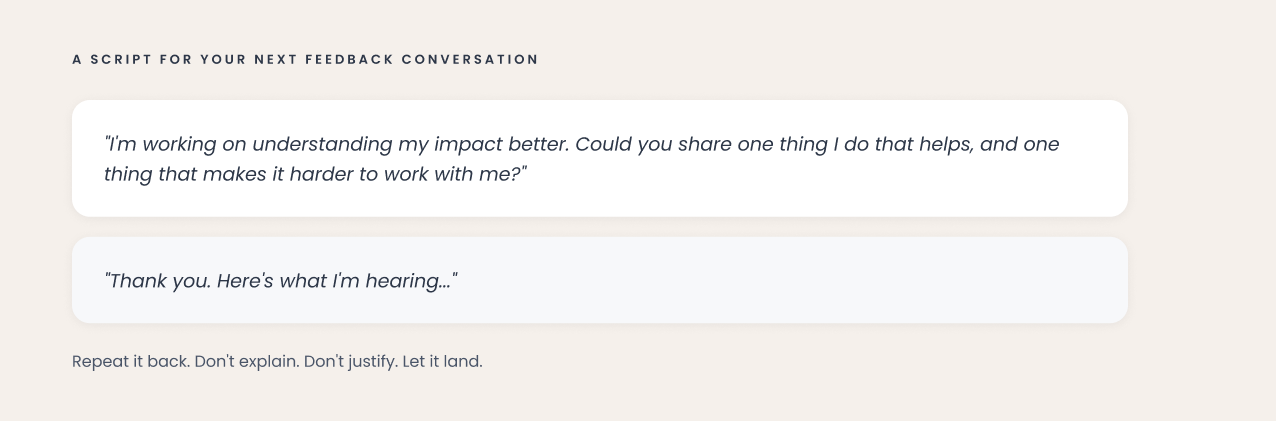
Marshall Goldsmith’s feedforward approach helps here. Instead of asking people to evaluate your past, ask them to invest in your future: “What’s one behavior that, if I did more or less of it, would make me a better leader for you?” It focuses the conversation on what comes next, not what went wrong.
Turning Insight Into New Habits
Awareness without action is self-indulgence. The final step is converting what you’ve learned into different behaviour.
This takes longer than most people expect. The popular claim that habits form in 21 days is a myth. Research from University College London found the median is 59-66 days. Leaders who began with small, specific habits were 2.7 times more likely to sustain change than those who aimed big.
Position this as a 66-day experiment, not a personality transplant.
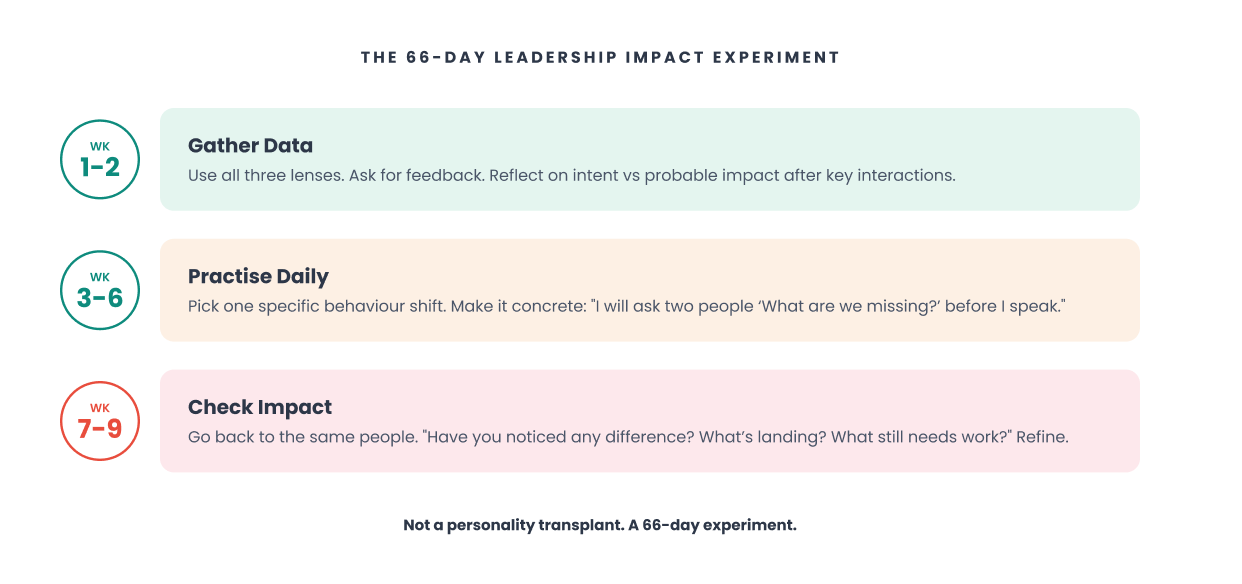
- Weeks 1-2: Gather data. Use all three lenses. Ask for feedback. Review any existing assessment data. Spend five minutes after key interactions reflecting on your intent versus your probable impact.
- Weeks 3-6: Pick one or two specific behavior shifts and practise daily. Not “be a better listener.” Something concrete: “In every meeting, I will ask at least two people ‘What are we missing?’ before I share my view.” Track it. Notice what changes.
- Weeks 7-9: Check your impact. Go back to the people you asked in weeks 1-2. Run a quick pulse: “Have you noticed any difference? What’s landing? What still needs work?” Refine based on what you hear.
Example: From “Interrupting” to “Inviting”
- Target behavior: “My team feels heard in meetings.”
- Daily micro-habit: “In every meeting, I will ask at least two people ‘What are we missing?’ before I speak.”
- Weekly check: Ask one person: “Did you feel you had enough space to contribute this week?”
- 66-day measure: Compare team input in meeting notes from week one to week nine. Count how many different voices are contributing.
When You Shift, Your Team Follows
Leadership behavior is contagious. This is the part that makes the 66-day experiment worth the discomfort.
Team members are 3.4 times more likely to adopt new work habits when their leaders visibly practise those habits themselves. When you model asking for feedback, when you say “here’s what I’m working on” in front of your team, when you respond to criticism with curiosity instead of defensiveness, you give everyone else permission to do the same.
We saw this play out at the Housing Ombudsman Service. Primeast was commissioned to implement a strengths-based philosophy across the organization. It started with leadership workshops and coaching, helping managers play to their strengths and encourage the same from their people.
The shift was deliberate, stated and signed by Housing Ombudsman. The results were striking. New complaints processed rose 51%. Cases investigated increased 62%. Average investigation time dropped from 30 weeks to 21. The total performance uplift exceeded 50%, worth roughly £1.85 million in added value. As the Housing Ombudsman put it, a simple shift in philosophy improved performance, raised employee engagement, and strengthened confidence in the entire service.
That started with leaders changing how they saw themselves and their teams. The operational results followed.
People push back more, because they feel safe. You hear fewer surprises in formal feedback, because the informal channels are open. Team energy in meetings shifts from guarded to direct. Psychological safety, the shared belief that the team is safe for interpersonal risk-taking, is the foundation. And it starts with the leader.
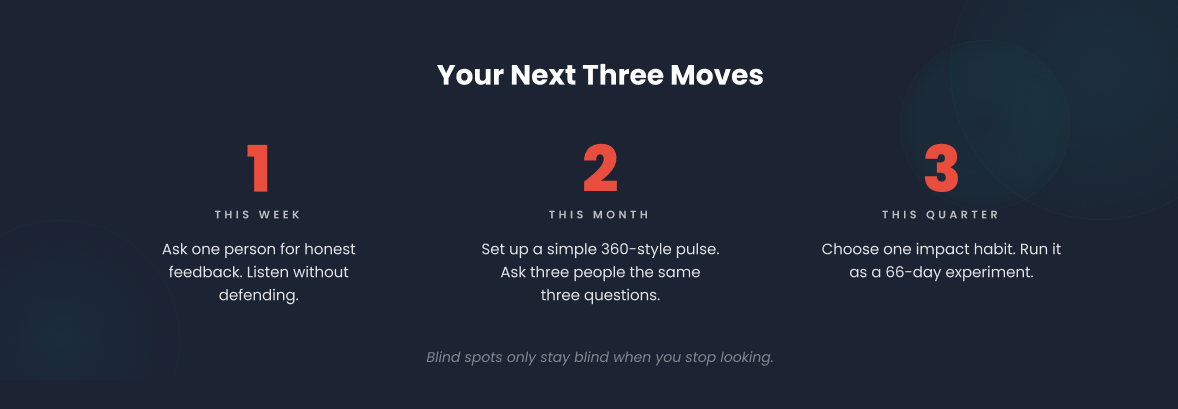
Most leaders mean well. The gap between intent and impact isn’t a character flaw. It’s a blind spot. And blind spots only stay blind when you stop looking.
Start with one question. See what you find.
Ready to Move Forward
Most leaders mean well.
Strategies only work when your leaders have the confidence and capability to use them. Primeast combines change management training with consulting and coaching to help organizations move from planning to lasting change.
How we help: Change Management Training · Change Consulting · Leadership Coaching