
Ever notice how quickly a simple workplace behavior turns into a full internal narrative about someone’s intent or commitment?
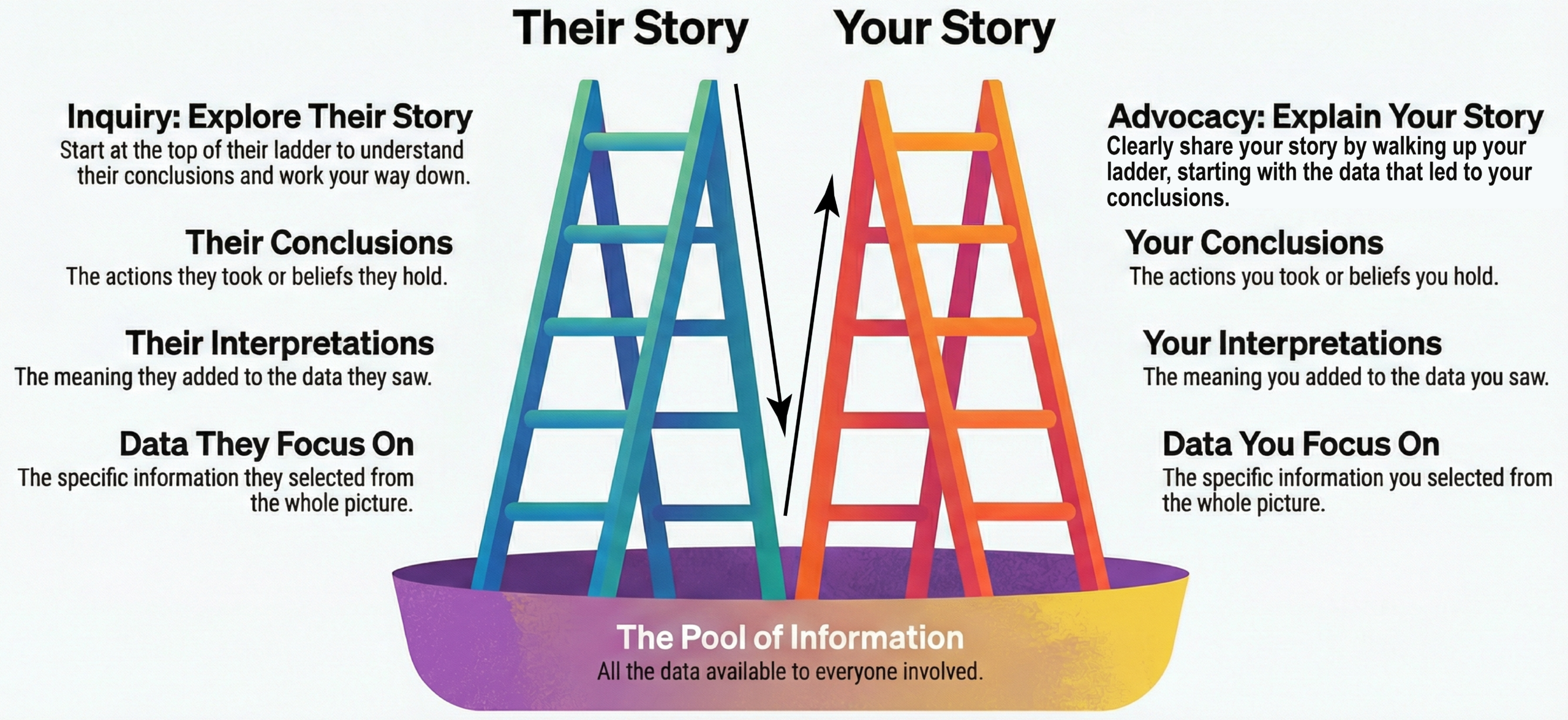
That rapid storytelling is the Ladder of Inference – a concept introduced by Chris Argyris and later popularized by Peter Senge. And it shapes real decisions:
- Who gets coached
- Who gets opportunities
- Who gets labeled “difficult.”
The ladder isn’t the problem – it’s automatic. The risk is climbing it unconsciously and then acting like your story is fact.
The Challenge
Picture this:
You send an urgent request to Sam, a reliable team member. Hours pass with no reply. Later, you see Sam laughing with a colleague in the hallway.
Your mind moves fast:
- Observable data: No response yet. Sam laughing in the hallway.
- Meaning added: “They’re not taking this seriously.”
- Assumption: “I’m not a priority.”
- Conclusion: “Sam is disengaged.”
- Action: You prepare to address their “attitude.”
By the time you speak, you’re no longer neutral – you’re corrective. Sam senses it. The conversation tightens before it even begins.
What you didn’t know: Sam was handling a production error, had already contacted IT, and was waiting until they had a real ETA before updating you.
A few selected data points shaped a belief, and could’ve strained a relationship.
Strategize
Leaders climb the ladder because the brain is optimized for speed, not precision. In ambiguity, it fills in gaps. The discipline isn’t to eliminate interpretation – it’s to test it before acting on it.
Three practices keep you from turning a story into unnecessary conflict:
1. Separate fact from interpretation
Ask yourself:
- What did I actually observe?
- What did I assume?
If you couldn’t capture it on video, it’s probably an interpretation.
2. Name the story privately
“This is the story I’m telling myself.”
That phrase creates distance and interrupts escalation.
3. Replace certainty with inquiry
Instead of climbing higher, climb back down. Gather missing data before deciding what’s true.
Skip this step, and the cost is real: eroded trust, biased decisions, self-fulfilling prophecies.
Dig Deeper
Most leaders understand the theory. The friction point is execution: how do you ask for clarity without sounding accusatory?
Tone, facial expression, and intent do as much work as your words. If you feel activated, pause and do a quick Ladder reset:
- What data am I selecting?
- What meaning am I adding?
- What assumption am I making?
- What else could be true?
Then choose a question that starts with what you observed, not what you assumed.
Take Action
Return to the original situation.
A reactive approach:
“Sam, I need you to prioritize my requests.”
A Ladder-informed approach:
“Sam, I didn’t hear back on the urgent request this morning, and later I saw you talking in the hallway. I started telling myself it wasn’t a priority. Can you help me understand what was going on?”
Notice the shifts:
- Observable data is shared
- Interpretation is named as a story, not a fact
- Sam is invited to add missing context
Sam explains the production issue and IT escalation. The conversation moves from accusation to alignment.
Then the leader closes with a future-focused question:
“What would help us make sure I have visibility into urgent updates next time?”
That’s the difference between a moment of tension and a better working agreement.
Before your next corrective conversation: check your data, name your story, and lead with curiosity.