
When things go wrong, do your team members climb toward solutions or sink into excuses?
The Challenge
Imagine you’re in a project review. One person says, “Nobody told me it was due.” Another adds, “This software just slows everything down.” Someone else mutters, “I was hoping the problem would work itself out.” Sound familiar? These are classic examples of employees functioning below the line on the Accountability Ladder – unaware, blaming, rationalizing, or hoping problems disappear.
Strategize
The Accountability Ladder (adapted from The Oz Principle by Roger Connors, Thomas Smith, and Craig R. Hickman) highlights eight rungs of accountability.
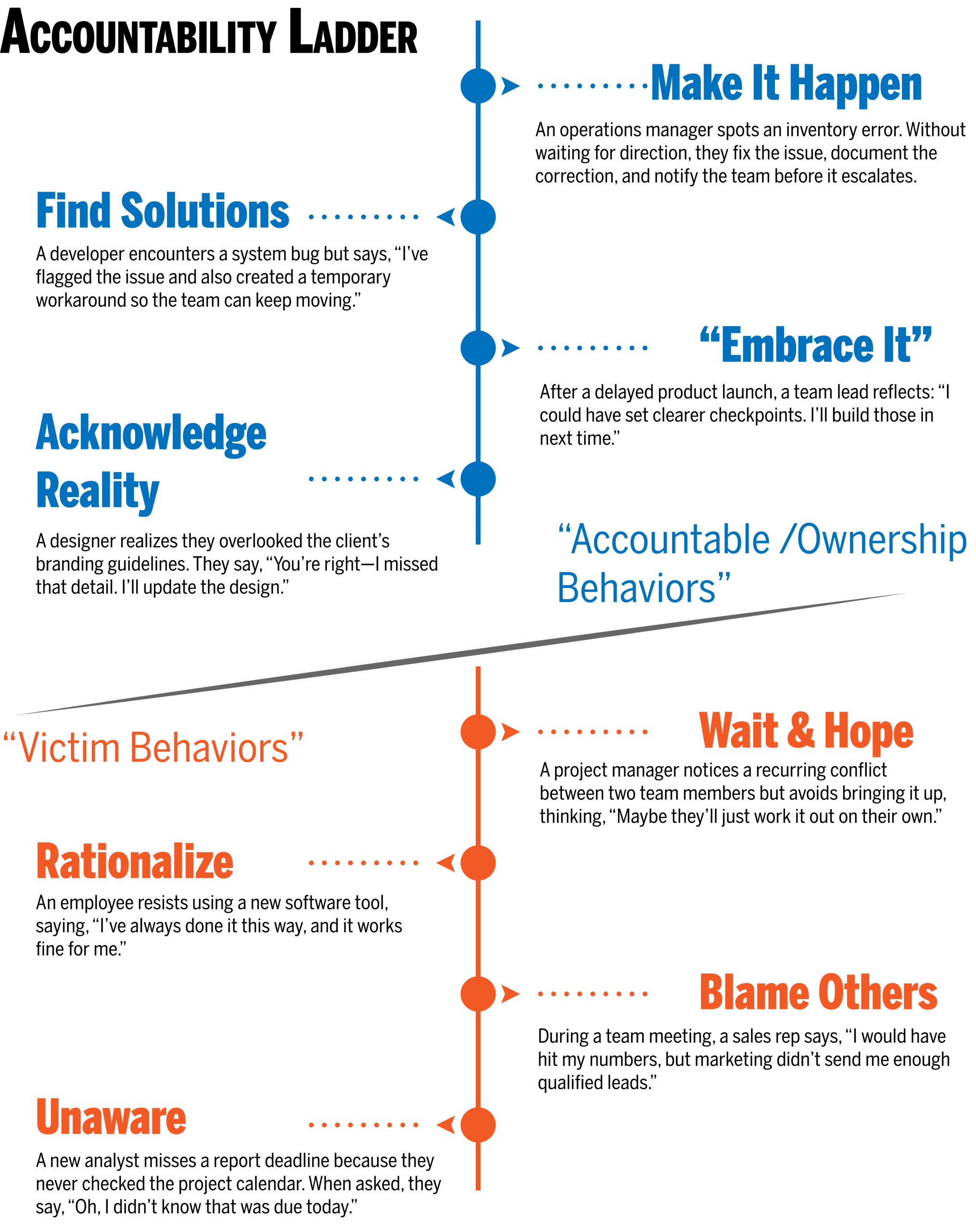
The first four—unaware, blame, rationalize, and hope the problem would just go away—symbolize the “victim mode.” The top four—accept, own my role, find solutions, and then make it happen – are above the line behaviors, where initiative and ownership thrive.
Leaders who can diagnose where someone sits on the ladder and coach them upward.
Dig Deeper
Here’s how to apply the ladder to coach your team up:
- Unaware: A new hire who misses tasks simply because they don’t know expectations. → Coaching: clarify roles, provide training, set clear timelines.
- Blame: A team member saying, “If marketing had done their part, we’d be fine.” → Coaching: ask, “What’s in your control to move this forward?”
- Rationalize: “I’ve always done it this way.” → Coaching: connect change to benefits and impact, not just compliance.
- Wait & Hope: Avoiding a tough client call. → Coaching: role-play scenarios and reinforce accountability to follow through.
Take Action
As a leader, you are the example your team follows. Model the top rungs by:
- Being open about your own missteps
- Showing how you turn them into learning opportunities
- Reinforcing team members who take responsibility and act proactively.