Why does performance drop right when the change begins?
Challenge
Your company has just rolled out a new system. The training is complete. The messaging was clear. The team was on board. And then… performance drops. Productivity slows. Errors increase. Even your strongest performers seem hesitant or frustrated. What changed? Why does performance dip when change begins?
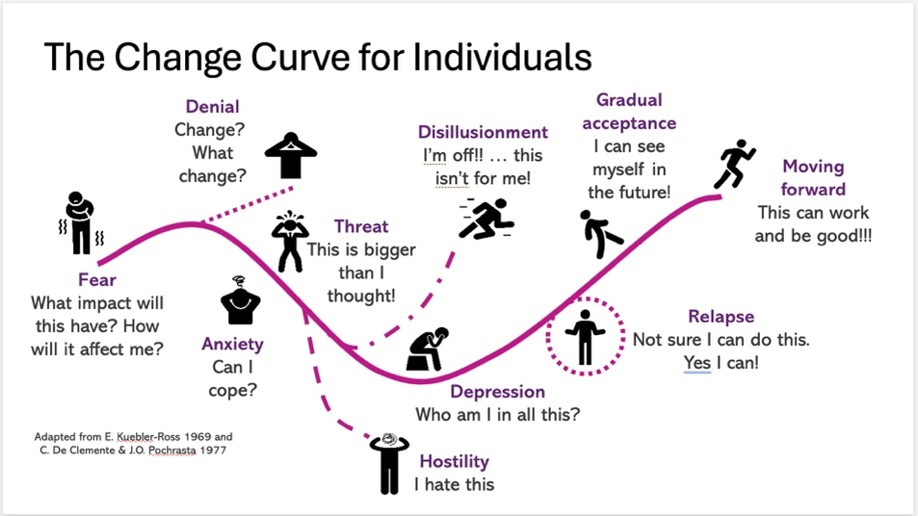
Kübler-Ross Change Curve (adapted from the Elisabeth Kübler-Ross Foundation
In the majority of cases, the stall is not just technical; it is the visible manifestation of the Kübler-Ross Change Curve. While leaders often see a “performance issue,” employees are navigating psychological stages: Denial (about the need to do things different), Anger (that they have not been trained well), Bargaining (hoping they have a little more time to figure out new system), Depression (this new system is too unfamiliar and they won’t catch up), and finally, Acceptance (finally feeling confident and organized around the new system). Pushing for speed during these phases acts as a brake, deepening the stall and increasing resistance.
Strategize
A common trap for leaders is forgetting that change is not a single moment – it’s a journey with different starting lines. While change happens at a point in time, the transition that follows unfolds over many moments. Each person moves through that transition differently, shaped by their own experiences, beliefs, and readiness.
- Leaders are “Ahead of the Curve”: By the time a change is announced, leaders have usually had weeks to process the news and move toward acceptance.
- Employees are “Entering the Curve” at different points: When the news hits, employees may just be starting at the beginning of the curve (Denial/Anger), or based on previous experience, may be entering further along the curve.
Because leaders have already processed their emotions, they may misinterpret an employee’s natural emotional response as “lack of buy-in” or “unnecessary resistance.”
Dig Deeper
Start looking at unexpected or unsatisfactory outcomes, or friction, to understand more about where each person is on the curve. Find individual ways to acknowledge, respond, and coach the employees in their journey through the change curve.
| Look for… | Interpretation | Leadership Response |
| Clustered Errors | Process is misunderstood (Loss of Fluency). | Teach: Host a “mistake-share” session to troubleshoot the workflow. |
| Slower Execution | Cognitive overload or “Bargaining” (trying to keep old ways a little longer). | Simplify: Temporarily remove non-essential tasks to free up mental space. |
| Silence/Withdrawal | Fear of incompetence or the “Depression” phase. | Normalize: Explicitly name “The Dip” and validate that the struggle is expected. Find ways to support competence or balance. |
| Vocal Resistance | Frustration or “Anger” regarding the loss of the old system. | Listen: Ask open-ended questions to understand what they feel they are losing and help them reframe their experience. |
Take Action
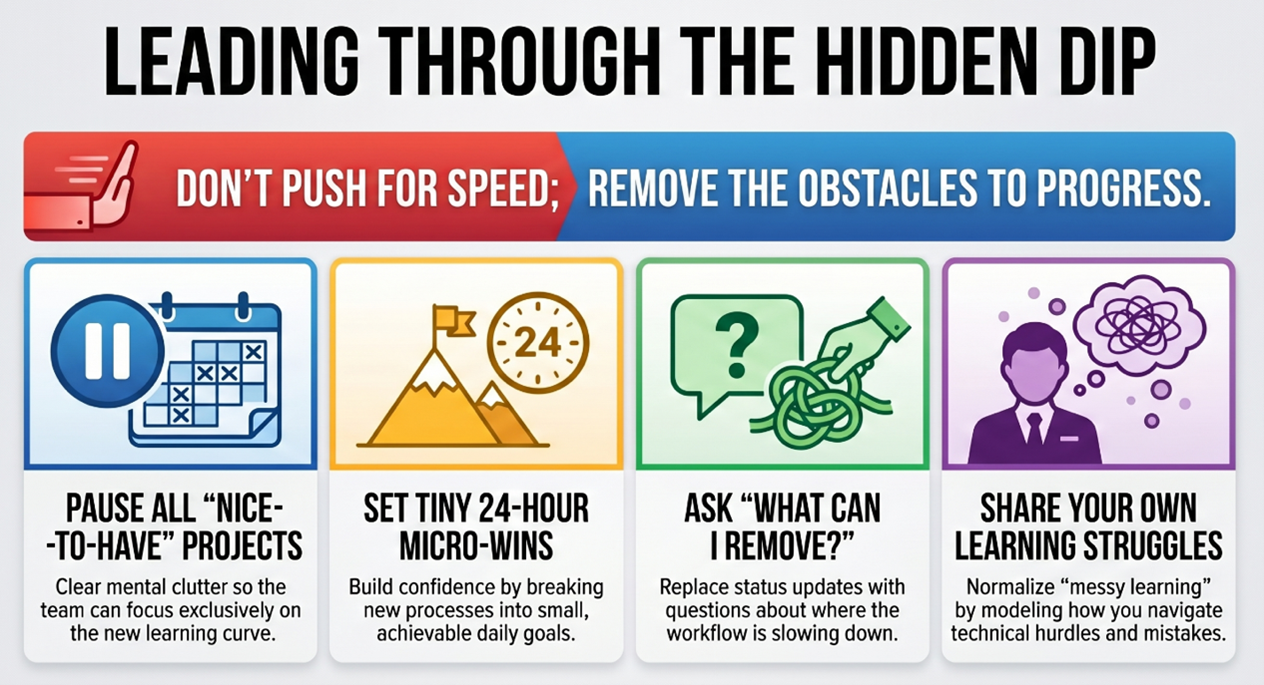
Don’t just wait for the stall to end. Use these high leverage moves to bridge the alignment gap and stabilize the team. Instead of asking “Is it done?”, pivot to check-ins that address the emotional and technical hurdles:
- “How are you feeling about this change now that we’re in the middle of it?”
- “What part of the new process is the most frustrating or confusing right now?”
- “What are you looking forward to, or what do you miss most about the old way?”
Purposeful Prioritization
Clear the “mental clutter.” Temporarily pause “nice-to-have” projects so the team can focus exclusively on the new learning curve. If everything is a priority during the stall, nothing gets mastered.
Manufacture “Micro-Wins”
Break the new process into tiny, 24-hour goals. Confidence is built on evidence, not pep talks.
- Example: Instead of “Master the new billing system,” set a goal for Tuesday: “Successfully process one single invoice using the new template.”
Model “Messy Learning”
Share your own struggles with the change to lower the stakes. For example: “I tried to run the weekly report on the new platform this morning and I completely locked myself out because I missed a step. It reminded me how much focus this requires. If you’re hitting walls like that, you’re in good company. Let’s keep sharing these ‘fails’ so we can fix them faster.”
Offer Visible Support
Be transparent about the timeline. Acknowledge that acclimation takes time and that you are there to provide resources, answer questions, and remove obstacles, not just monitor results.
For more information about how to develop your leaders, create more connection on your teams, and leverage these Coaching Tips within your organization, email [email protected].