The short version
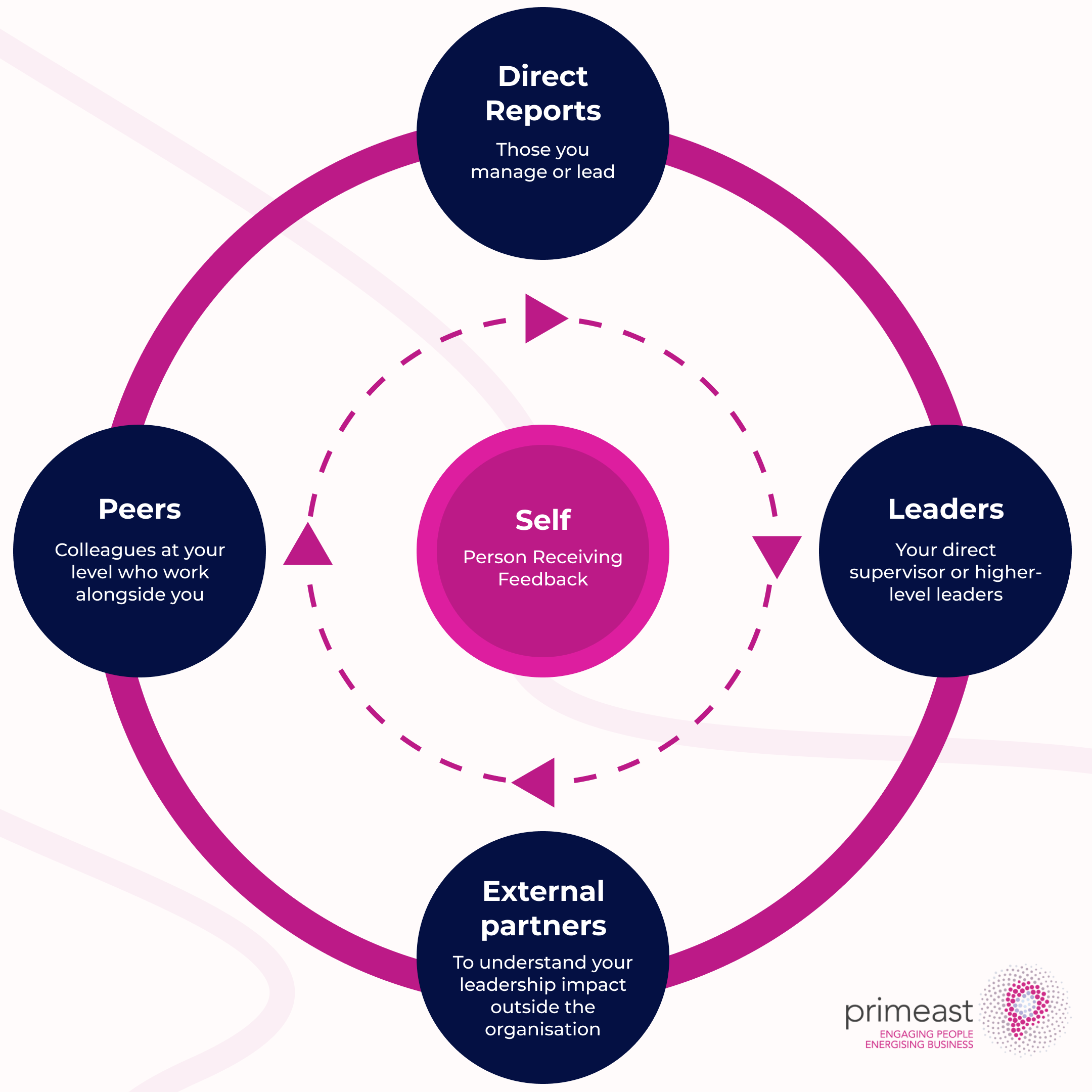
A 360 degree leadership assessment gathers confidential feedback on a leader from everyone around them, their manager, peers, direct reports, and sometimes clients, to show how their leadership is experienced, not just how they see it themselves.
A 360 degree leadership assessment is a feedback process that gathers confidential, structured input on a leader’s behaviour from the people around them: their manager, peers, direct reports, and in some cases clients. Unlike a top-down appraisal, it builds a rounded, multi-source picture of how a leader’s impact is experienced day to day.
At Primeast, we believe better awareness builds better leaders. That’s why our leadership development programmes start with a 360-degree assessment, because real growth starts with real insight.
The answer isn’t always more training. It’s better insight.
This guide explains what a 360 assessment measures, what it asks, what it reveals, where it goes wrong, and how to run one that changes behaviour rather than gathering dust.
Feedback from every direction
A 360 view of how your leadership lands
Five perspectives, including your own, aggregated into one honest picture.
Why Traditional Feedback Leaves Leaders in the Dark
Most leaders are working from a partial picture of themselves. Not because they lack self-awareness, but because the feedback reaching them has been filtered.
The higher you rise, the less honest the feedback becomes. People manage upwards. They tell you the version that protects the relationship, smooths the meeting, or avoids the risk of disagreeing with someone senior. Praise travels easily. The difficult truths rarely make the journey.
A single source makes it worse. Your manager sees one slice of your behaviour, usually the version you show when you are being managed. They don’t see how you land in a one-to-one with a nervous junior, or how your team reads your silence in a crisis. No one vantage point holds the whole picture.
That’s the gap a 360 closes. Instead of one filtered view, it collects many, from the people who experience your leadership from every side. The blind spots you can’t see from the inside, and the strengths you overuse without noticing, finally become visible.
How a 360 leadership assessment works
A 360 assessment follows a clear sequence. Done properly, each step protects the honesty of the one before it.
- Set the purpose. Decide up front that this is for development, not judgement. That single decision shapes everything that follows.
- Choose the raters. The leader and facilitator agree a group: the manager, a spread of peers, direct reports, and sometimes clients or partners.
- Select the instrument. Pick the questionnaire or assessment tool that fits the leadership behaviours you care about.
- Gather the feedback. Raters respond confidentially, scoring a set of statements and adding written comments.
- Aggregate the results. Responses are grouped by rater type, never attributed to individuals, so people can be candid.
- Debrief with a skilled facilitator. This is where data becomes insight. A trained facilitator helps the leader read the patterns without defensiveness.
- Build a development plan. The leader chooses one or two specific shifts to work on, with support.
- Re-measure. A follow-up assessment later tracks real movement.
The honesty lives in two design choices: confidentiality, so people tell the truth, and the debrief, so the truth is heard rather than rejected. Skip either and the process hollows out.
The real insight comes through conversation. That’s why we always combine the report with expert debriefing and coaching. Because feedback alone doesn’t drive change. Understanding and support do.
What questions does a 360 leadership assessment ask?
A 360 questionnaire turns leadership into a set of observable behaviours, then asks each rater how often they see them. Most use a simple frequency or agreement scale, usually one to five, alongside two or three open questions such as “what should this leader keep doing?” and “what should they do differently?”
The statements are grouped by competency. Here is a representative set of the kind of questions a leadership 360 asks, organised by the areas most assessments cover.
Self-awareness and emotional regulation
- Stays calm and considered under pressure.
- Is aware of how their mood affects the people around them.
- Actively seeks feedback and acts on it.
Communication
- Explains the reasoning behind decisions clearly.
- Listens to understand, not just to reply.
- Keeps people informed before they have to ask.
Relating to and developing others
- Gives people genuine ownership of their work.
- Invests time in developing others, not only in delivering tasks.
- Gives credit generously and takes responsibility when things go wrong.
Decision-making and judgment
- Makes timely decisions without needing every detail first.
- Balances short-term delivery with longer-term thinking.
- Involves the right people before settling on a direction.
Leading change
- Helps the team make sense of change rather than just announcing it.
- Stays steady and present when priorities shift.
Integrity and trust
- Does what they say they will do.
- Treats people fairly and consistently.
- Can be trusted with a difficult conversation.
The open comments are often where the real insight sits. A score tells a leader where they stand. A sentence in someone’s own words tells them why.
What a 360 actually asks
Six areas a leadership 360 measures
Each rated on a simple scale, with space for comments in people’s own words.
What It’s Like to Go Through One
Laura had been leading her team for two years when she went through her first 360. She expected confirmation. What she got was a mirror.
The scores from her team told a consistent story. They found her brilliant under pressure and quick to solve problems, but they rarely felt trusted to solve those problems themselves. One comment stayed with her: “I learn most when she’s on holiday.” It stung, and it was the most useful thing anyone had told her in years.
That moment, the gap between how Laura saw her leadership and how her team felt it, is what a 360 is built to create. It is rarely comfortable. It is almost always the beginning of something. The discomfort is not the process failing. It is the process working.
What the results reveal
A good 360 surfaces four things a leader cannot easily see alone.
The first is overused strengths. The decisiveness that built your reputation can read as steamrollering to the people downstream of it. A 360 shows where a strength has tipped into a liability.
The second is blind spots, the behaviours everyone else has noticed and no one has named. The third is the gap between your self-rating and how others score you. That gap is one of the most revealing parts of the whole exercise. Research from the Center for Creative Leadership has found that the leaders who improve most after a 360 are often those who initially rated themselves more highly than their colleagues did. Seeing that gap honestly is what starts the change.
The fourth is pattern. Individual comments are data points. Read together, with help, they reveal the handful of themes that shape how a leader is experienced. This is also the foundation of any serious work on understanding your leadership impact.

360 assessment vs a traditional appraisal
A 360 is often confused with a performance appraisal. They are different instruments doing different jobs, and using one as the other breaks both.
Know the difference
A 360 is a development mirror, not an appraisal
Tie a 360 to pay or promotion and the honesty drains out of it.
The moment a 360 is tied to pay or promotion, the honesty drains out of it. Raters hedge, recipients defend, and you are left with a politely useless report. A 360 is a development mirror, not a verdict.
Drawbacks of 360 feedback, and how to avoid them
A 360 can go wrong. Most criticism of the method targets how it is run, not the method itself. Here are the failure modes worth knowing, and how a well-designed process avoids each.
Used as appraisal.
When feedback is tied to pay or promotion, people game it. Keep the 360 firmly in the development lane, separate from formal performance decisions.
Anonymous, but not safe.
Confidentiality means little if the culture punishes candour. A 360 works best where leaders have already shown they can hear hard feedback without retaliation, which is why starting with senior leaders matters.
Untrained raters.
People who have never given structured feedback often default to vague praise or unhelpful criticism. A short brief on how to give specific, behavioural feedback transforms the quality of the input.
Survey fatigue and generic questionnaires.
A bloated, off-the-shelf survey that ignores the actual job produces tired, shallow answers. Keep it focused on the behaviours that matter for this role.
No debrief, no follow-up.
This is the big one. A report handed over without a skilled conversation is just data, and data rarely changes anyone. The CCL’s research is clear that the leaders who improve are the ones who follow up, ideally with feedback sessions and coaching. A 360 without a debrief is a diagnosis with no treatment.
That last point matters more than any of the others. Evaluative feedback, the kind that feels like a verdict, triggers the brain’s threat response, and people stop listening. Feedback framed as development, explored in a safe conversation, engages the part of the brain that learns. The science behind this sits underneath our work on emotional intelligence and self-awareness. The tool surfaces the truth. The debrief makes it usable.
Where 360s go wrong
Five pitfalls, and how to design them out
Why We Use the Leadership Circle Profile
Most 360 assessments measure the outer game: the behaviours other people can observe. That is useful, but it stops at the surface. A leader learns that others see her as controlling, or poor at delegation, and now she has awareness. Awareness on its own rarely shifts behaviour, because under pressure she will default to the same patterns.
The Leadership Circle Profile goes a layer deeper. Alongside the outer game, it measures the inner game: the beliefs and assumptions driving the behaviour. It maps a leader’s results across Creative competencies, the ways leaders operate from purpose and vision, and Reactive tendencies, the ways they operate from fear and self-protection.
Take the manager who micromanages. A traditional 360 stops at “you control too much, your team feels you don’t trust them.” The Leadership Circle Profile surfaces the belief underneath: “if I don’t control the details, it all falls apart, and my value is being the expert.” With coaching, that belief can move to “my value is enabling others to succeed.” That shift, from what to why, is where behaviour actually changes. It is the same territory we explore in recognising and interrupting your reactive leadership patterns.
What most 360s miss
The behaviour, and the belief beneath it
Change the belief, and the behaviour changes with it.
Is a 360 assessment right for your organisation?
A 360 rewards organisations that are ready for it and frustrates those that are not.
The green lights are a genuine development culture, leaders willing to act on what they hear, and enough psychological safety that people will tell the truth. If senior leaders go first, share their own development areas openly, and visibly work on them, they make it safe for everyone below them.
The red lights are using it to inform pay or promotion, low trust, and no capacity to debrief or follow up. If you cannot resource the conversation after the report, the report will not land. Better to wait until you can do it properly than to spend goodwill on a process that stalls.
Frequently asked questions
How does a 360 assessment work?
What questions does a 360 leadership assessment ask?
What are the disadvantages of 360 feedback?
What is the difference between a 360 and a performance appraisal?
Who takes part in a 360 assessment?
Is 360 feedback anonymous and confidential?
How long does a 360 assessment take?
How often should you run a 360?
How do you act on 360 feedback results?
Turning feedback into change
A 360 degree leadership assessment gives leaders something they almost never get otherwise: an honest, rounded picture of how their leadership lands. That picture is the starting point for every real development conversation.
But a report on its own changes nothing. The value is in what comes after: a skilled debrief that helps a leader hear the truth without flinching, and the coaching that turns one or two honest insights into lasting habits.
To run a 360 that changes behaviour rather than gathering dust, talk to us. We will help you choose the right instrument, prepare your people, and turn feedback into fuel for growth.